Run an airline on the real world map.
Open real routes between real airports, lease real aircraft, build hubs, and take the market from carriers that fight back. Free, in your browser, with nothing to sign up for.
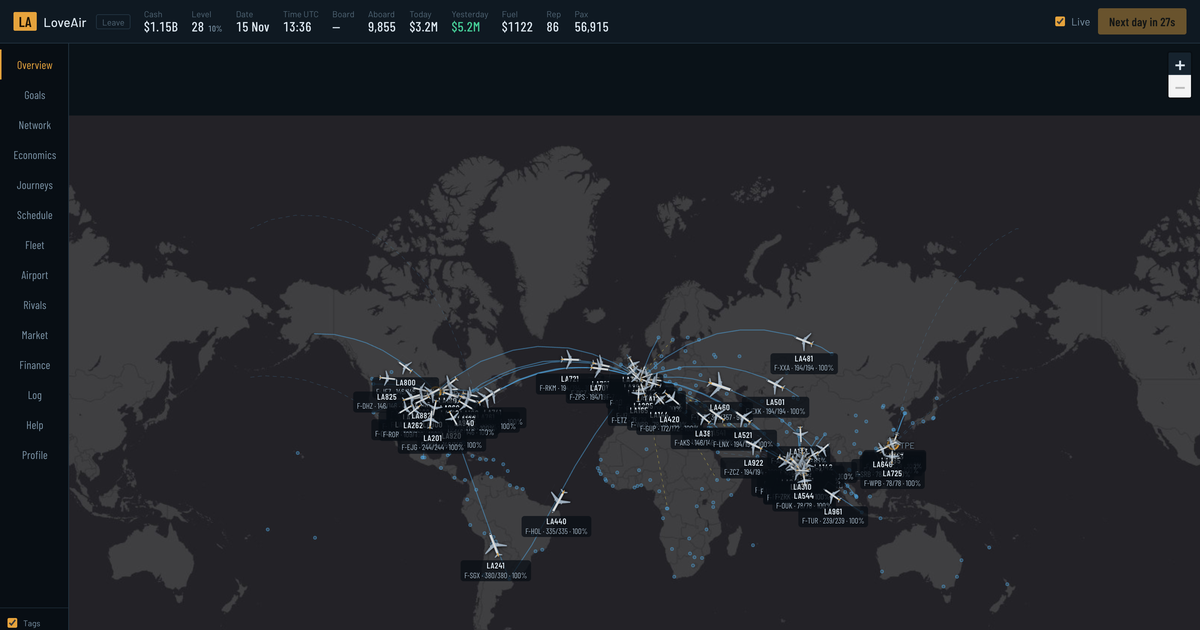
What you actually do
Every decision is the one a real airline makes, and the simulation answers it with the real numbers rather than a score.
Real airports, real aeroplanes
Every airport has its own catchment, runway length and movements an hour. Every aircraft has the range, seat count and fuel burn it actually has — and will not be assigned to a field it cannot physically use.
Rivals that fight back
Carriers are the size their cities deserve, and the good routes already have somebody on them. Fare, reputation, marketing and morale decide who wins the traffic. Choose three rivals, six, ten, or none at all.
Slots at crowded airports
Heathrow has a finite number of movements an hour and the incumbents hold most of them. Hold a slot and fly it, or lose it: use-it-or-lose-it applies, measured over thirty days.
Hubs that connect
Build a hub and a passenger from one spoke can reach another, so thin routes start carrying traffic they could never fill on their own. A hub carrying no connections is just an expensive airport.
Aircraft that have to get back
A rotation is built from real flying times and turnarounds inside a sixteen-and-a-half hour day. A long sector flown daily needs two aircraft at half a round trip each, and the schedule tells you so.
Money that runs out
Leases, fuel, slot fees, carbon and debt all come due. An eighteen-year-old Tupolev is a tenth the rent of a new Airbus and is sometimes the better answer.
How it works
Three decisions and you are in the air. The rest is the game.
-
Pick a base
Any airport on the world map, or on a country map — India, the United States, China, Brazil, Indonesia, Australia or Europe — which includes the smaller cities the world map leaves out.
-
Buy something you can afford
$25M is deliberately not enough for a new narrowbody. The used market is the intended path, not a setback.
-
Open a route and advance a day
Read the load factor and the profit, then decide: more frequency, a different fare, or close it and fly somewhere else.
Ways to play
The clock is yours. Nothing here waits on a server timetable or on other people being online.
On your own
A world of one, set up the way you want it: how long it runs, how many rivals, whether the industry is already flying or everybody starts from nothing.
With friends
Open a world and hand out the code. Up to eight airlines, all starting together on the same map.
At your own pace
Run the clock in real time — anywhere from fifteen seconds to twenty-four hours per day — and come back to what happened. Or go turn by turn, where nothing moves until you say so.